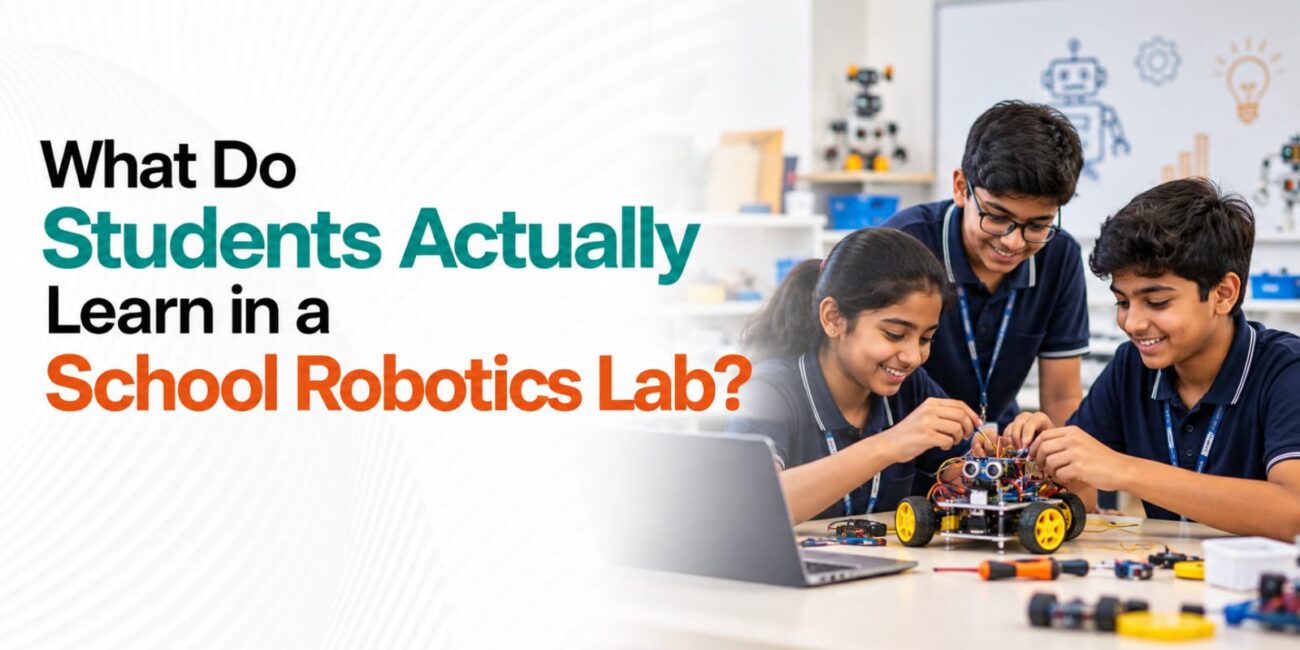
What Do Students Actually Learn in a School Robotics Lab?
In a school robotics lab, students learn how robots are built, how their parts work together, and how a program controls what they do. Depending on age and curriculum, sessions can cover robot construction, motors, sensors, programming, movement, and a good deal of experimenting.
A robotics lab for school students is not just a place to put a kit together. The real work starts after the build: students check whether the robot does what they intended, and change it when it does not.
What Do Students Learn in a School Robotics Lab?
Guided activities in a robotics lab usually touch six areas. Which ones a class covers, and how deeply, depends on the students’ age and the school’s programme.
Understanding Robot Components
Students first learn what each part is for. The frame gives the robot its shape and holds everything together. Wheels let it move, and gears change how fast or how forcefully something turns. Motors provide the turning power. The controller holds the program and tells the motors what to do. A battery supplies energy, and wires or connectors carry signals between parts.
Different kits include different parts. Younger students may snap together large pieces, while older students may handle exposed circuit boards.
Mechanical Design and Movement
Building a model shows students how design affects movement. A robot with its weight too far forward may tip. Larger wheels cover more ground per rotation. A small gear turning a bigger gear slows the motion but adds force.
Turning is a good example. On a robot with a motor for each wheel, running both wheels forward makes it go straight. Slowing or stopping one wheel makes it curve or turn. Students try this, watch the robot, and connect the wheel behaviour to the result.
Sensors and Electronics
A sensor collects information and sends it to the controller as a signal. A distance sensor estimates how far away an object is. A light sensor measures brightness, and a touch sensor detects contact. Students learn that a robot only “knows” what its sensors report.
With a distance sensor, a robot can slow down or stop near an obstacle. With a light sensor pointed at the floor, it can tell a dark line from a light surface, which is how line-following works. Basic electronics comes in here too: a circuit needs a complete path, and a loose connection can stop a robot completely.
Coding and Programming
Programming turns ideas into behaviour. Younger students often use block-based coding, where instructions are dragged into order. Older students may use text-based languages, depending on the learning platform the school has chosen.
Early programs are simple: move forward, turn, stop, repeat. Later ones respond to sensors, for example “if the distance is below a set value, stop; otherwise keep moving.”
Logic, Instructions and Automation
Three ideas drive most robot programs. A sequence runs steps in order. A condition lets the robot choose between actions. A loop repeats steps. When these are combined and the robot acts on its own in response to inputs, that is automation.
Students see the link between code and action directly. Swap two instructions and the robot moves differently. Change a number in a loop and it travels a different distance.
Building, Testing and Improving Robots
The lab routine is build, run, observe, adjust, run again. If a robot veers left, students might check wheel alignment, motor settings, or the program. They change one thing and test again.
This is the practical side of the work: noting what happened, deciding what to change, and checking whether it helped. If you want to read about the reasoning skills this builds, see our article on how a robotics lab supports problem-solving skills.
What Happens During a Typical Robotics Lab Class?
Here is one illustrative session. The format varies by school programme and grade level, so treat it as an example and not a fixed method.
1.The teacher introduces a task, such as making a robot stop before it reaches a wall.
2.Students look at the components they need.
3.They assemble or set up the robot model.
4.They write or adjust the program.
5.They run the robot and watch what it does.
6.They explain what worked and what they changed.
The last step matters. Describing a change in their own words shows whether students understand why the robot behaved as it did.
What Can Students Build in a School Robotics Lab?
Robotics lab activities range widely. These four show how common builds map to specific concepts:
A wheeled robot that moves and turns. Students learn how motor speed and direction control movement.
- An obstacle-detection robot. A distance sensor feeds the program, and students learn how an input leads to a decision.
- A line-following robot. A light sensor reads a marked path, and students learn how repeated sensor readings guide steering.
- A simple automated model. An example is a light that switches on in the dark. Students learn that a system can respond to an input without anyone pressing a button.
What Do Students Learn in a Robotics Lab at Different Grade Levels?
The progression below is illustrative, not a universal grade-wise curriculum. In practice it depends on students’ prior experience, the school’s curriculum, and the equipment available.
Primary grades: Students meet basic components, do simple construction, explore movement, practise sequencing, and follow guided activities.
Middle grades: Students combine components, use sensors, write basic programs, and complete structured tasks, such as navigating a simple course.
Secondary grades: Students work on more complex programming, connect several parts into one system, study automation, and take on increasingly independent projects.
How Is a Robotics Lab for School Different From a Regular Computer Lab?
A regular computer lab supports a wide range of digital learning, such as typing, documents, presentations, and coding on a screen. A robotics lab adds physical components, electronics, and testing. Students program something that moves, senses, and sometimes fails in ways a screen never shows.
The two spaces work well together. Coding skills practised in the computer lab carry over to robot programming, and robot projects give those skills a physical outcome.
How Schools Can Provide Meaningful Robotics Lab Learning
Good lab learning comes from planning more than from the equipment alone. Schools usually look at:
- A structured, age-appropriate curriculum
- Clear learning objectives for each session
- Suitable equipment and guided activities
- Teacher preparation and instructional support
- Activities that progress across grade levels
- Practical ways to review what students understood
Schools exploring a structured approach can look at TechnoSchool’s robotics lab solutions for schools. For context on how this works for schools in the country, see our page on the robotics lab for schools in India.
Conclusion
In a school robotics lab, students work with the full chain: mechanical construction and movement, sensors and electronics, programming, and automation. They test each idea on a real machine and improve it from what they see.
Learning works best when activities match the students’ age and build on earlier ones. School leaders and educators who want to see how this can be organised can explore TechnoSchool’s school robotics lab offerings.
Frequently Asked Questions
1. What do students learn in a school robotics lab?
They learn how robot components work, how sensors collect information, and how programs control movement. They also practise testing and adjusting their builds. The depth depends on the grade and the programme.
2. Do students need coding knowledge before joining a robotics lab?
No. Many programs start with building and simple block-based instructions. Coding skills develop over time, and prior experience can help but is not required.
3. What equipment is commonly used in a school robotics lab?
Common items include educational robotics kits with frames, motors, controllers, and batteries, plus sensors, connecting cables, and a computer or tablet for programming. Exact equipment varies by school and platform.
4. What robotics activities are suitable for primary school students?
Guided building, identifying parts, making a robot move in a straight line or turn, and following simple step-by-step instructions. Teachers usually demonstrate first and students then try it themselves.
5. How does robotics lab learning progress in secondary school?
Programming gets more complex, sensors and other parts are combined into one system, and students study automation and take on more independent projects. The exact path depends on the curriculum and earlier experience.