Schools have long taught science through textbooks and classroom experiments, and that still matters. What has changed is the expectation that students should also use what they learn: build something, test it and fix it when it fails. This is a large part of why STEM education, especially robotics, coding, engineering and AI, has come into focus for schools.
Traditional science labs and STEM labs both support practical learning, but they do different jobs. A science lab helps students understand a principle by testing it under controlled conditions. A STEM lab asks them to design, build and improve a solution using ideas from several subjects. This article explains how the two differ, how each builds future-ready skills, and how a school can use them together.
What Is a Traditional Science Lab?
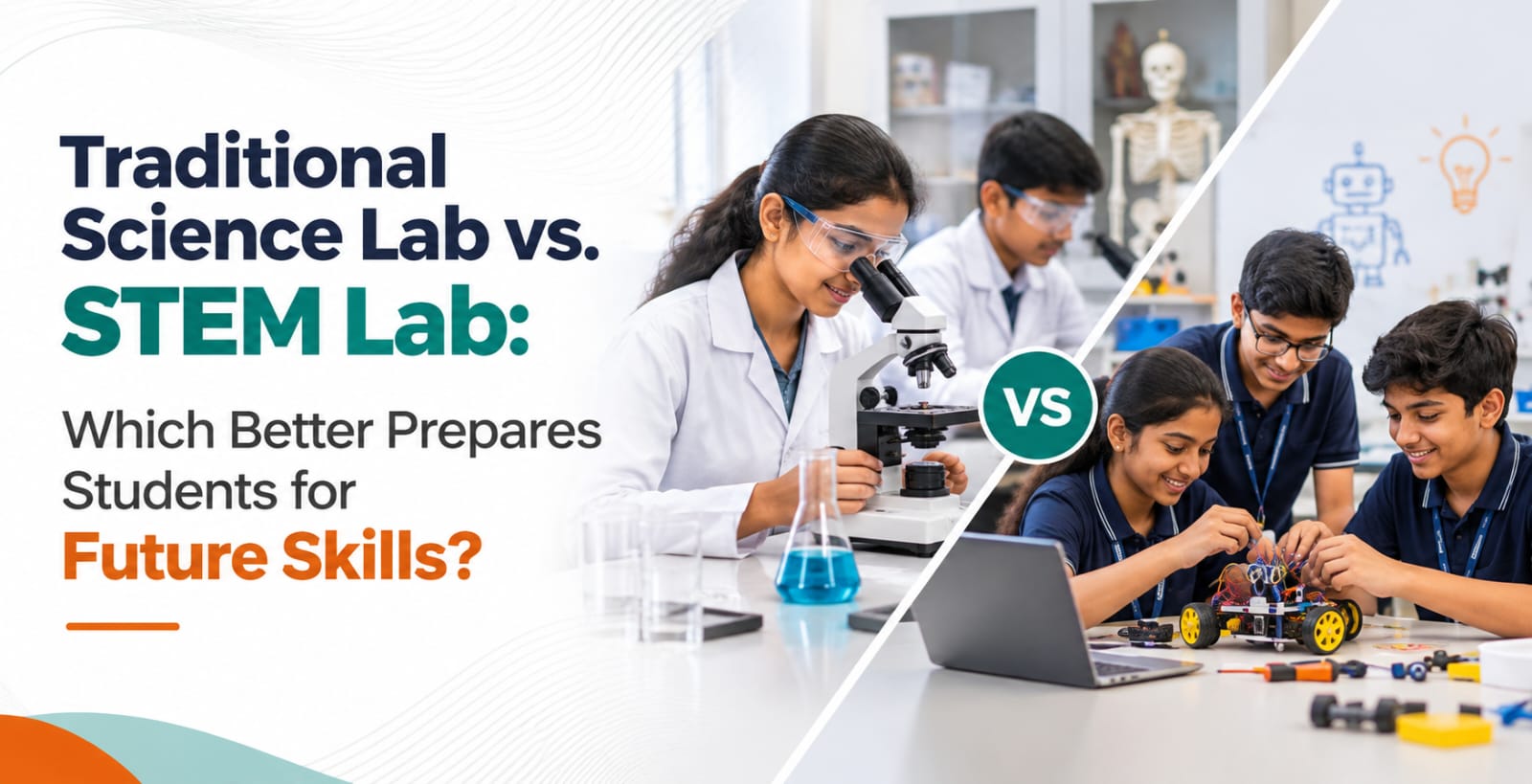
A traditional science lab is a dedicated space where students learn scientific concepts through experiments and observation. In most schools it supports physics, chemistry and biology. Students work with glassware, microscopes, chemicals, measuring instruments and specimens to see for themselves what the textbook describes. They might carry out an acid-base titration, look at plant cells under a microscope or verify Ohm’s law with a simple circuit.
These activities build skills that later science courses rely on: careful observation, accurate measurement and recording, following a procedure and handling equipment safely. The fixed method lets students concentrate on what the result shows and whether they measured it well.
What Is a STEM Lab in Schools?
A STEM lab is a learning space where students work on practical projects that combine science, technology, engineering and mathematics. Instead of an experiment built around one subject, a project asks students to draw on several subjects to solve a problem.
A school STEM lab may have robotics kits, electronic components, microcontroller boards such as Arduino, sensors, motors, coding platforms and age-appropriate AI learning resources. Typical projects include an obstacle-avoiding robot, a simple automated irrigation system or a temperature-monitoring device. To finish them, students have to understand the problem, plan a solution, apply the science and maths involved, build and test a model, and then find and fix their errors. Older students also meet automation, AI and the Internet of Things (IoT), introduced at a level that suits their age.
For a wider look at practical, interdisciplinary learning, see our guide to STEM education in schools.
Traditional Science Lab vs. STEM Lab: Key Differences
| Comparison factor | Traditional science lab | STEM lab |
| Main purpose | Understand scientific concepts through experiments | Apply concepts to design and build solutions |
| Learning method | Structured, guided experiments | Project-based learning |
| Subject integration | Mostly individual science subjects | Science, technology, engineering and mathematics together |
| Typical equipment | Glassware, microscopes, chemicals, measuring instruments | Robotics kits, sensors, motors, microcontrollers |
| Practical application | Testing established scientific principles | Developing models and working solutions |
| Student participation | Following experimental procedures | Planning, building, testing and improving projects |
| Technology | Mainly scientific measuring instruments | Coding, electronics, robotics and AI learning tools |
| Skills developed | Observation, measurement, scientific reporting | Problem-solving, computational thinking, collaboration |
| Learning outcome | Understanding scientific concepts | Applying concepts through practical projects |
Neither environment is better in every respect. Science labs build scientific understanding and experimental accuracy. STEM labs let students use that knowledge in interdisciplinary projects.
How Does a STEM Lab Help Students Develop Future-Ready Skills?
Technology now runs through many industries, so subject knowledge on its own is not enough preparation. STEM projects give students a practical way to build the other skills.
Problem-solving and critical thinking
Building a robot means running into problems. If it does not follow its intended path, students have to work out whether the cause is the programming logic, the sensor placement or the wiring. Checking each possibility in turn teaches them to analyse a problem, test an approach and improve it. A closer look at how a robotics lab supports problem-solving skills shows this process step by step.
Computational thinking
Computational thinking means breaking a large task into smaller steps, spotting patterns and writing logical instructions. In coding activities, students use sequences, loops and conditional statements. Programming a line-following robot makes this concrete: the instructions they write decide how the machine moves, and a mistake shows up on the track straight away. It also lays groundwork for programming and computer science in later years.
Engineering design and creativity
STEM projects take students from an idea to a working model. They plan, build, test and change the design based on what the test showed. In a bridge-building challenge, for instance, students can try different structures and materials and see how each affects stability and load distribution. That kind of experimentation builds creativity along with engineering thinking.
Collaboration and teamwork
Many projects run in small groups with shared jobs. One student may handle the programming, another assembles the components, and others test the model and record the results. Working this way, students have to explain their ideas to each other and see how different people approach the same problem.
Digital literacy and technology awareness
Hands-on work with coding platforms, electronic components, digital tools and robotics systems makes students more familiar with technology. Age-appropriate activities can also introduce basic AI, such as how a machine uses data to spot patterns and perform a task. Both help students feel more comfortable exploring new technologies.
Practical Learning Examples: Traditional Science Lab vs. STEM Lab
Both labs can teach the same concept. What differs is what students do with it.
Temperature
In a science lab, students heat water, record the temperature at regular intervals and plot the readings on a graph. This teaches them how temperature changes and how to measure it. In a STEM lab, they connect a temperature sensor to a microcontroller and program an alarm that goes off when the reading crosses a chosen threshold. The first activity is about measurement. The second shows how that data can drive an automated system.
Plants and water
In a science lab, students observe how different conditions affect plant growth and water loss. In a STEM lab, they build a simple irrigation model with a soil moisture sensor and a small water pump, programmed to switch on when the soil moisture falls below a set level. The second activity links biology with electronics, coding and automation.
Speed and distance
In a science lab, students time a trolley over a set distance and calculate its speed. In a STEM lab, they program a line-following robot, measure its movement along a track and adjust its motor settings to improve its performance. Both activities cover motion, measurement and calculation, applied in different ways.
For more interdisciplinary ideas, see these cross-curricular robotics projects in STEM education.
Can STEM Labs and Traditional Science Labs Work Together?
Yes, and each makes the other stronger. A science lab gives students the principles. A STEM lab gives them a reason to use those principles. Students who have studied electrical circuits and verified Ohm’s law in the science lab can apply that knowledge to build a sensor-based circuit in the STEM lab. Likewise, what they learn about motion in physics helps them understand how a robot moves and how to program it.
Schools can strengthen the link by matching STEM projects to topics already covered in science and mathematics lessons, so students move from understanding a concept to applying it.
What Should Schools Consider Before Introducing a STEM Lab?
Buying robotics kits and electronic equipment is only part of setting up a STEM lab. The larger question is whether the programme will support the curriculum and give students meaningful learning. Six factors are worth checking.
Curriculum alignment
The programme should connect with what students learn in science, mathematics and computer education. Look at how its projects fit your existing curriculum and learning objectives.
Age-appropriate equipment
Equipment should suit students’ learning levels and technical understanding. As a rough guide:
- Classes 1 to 5: basic building kits, simple electronics and introductory block-based coding.
- Classes 6 to 8: robotics projects, sensors, motors and intermediate coding activities.
- Classes 9 to 12: advanced robotics, Arduino-based projects, IoT and introductory AI applications.
These levels are indicative. Final choices should depend on the students’ abilities and the programme curriculum.
Space and infrastructure
Check the classroom space available, storage, electrical connections and access to computers or tablets. A dedicated STEM space can be planned around what the school already has and what the programme needs.
Coding and AI learning resources
Choose coding platforms and technology resources for the age and goals of each group. Younger students can start with visual, block-based coding. Older students can move on to text-based programming, automation, AI concepts and IoT applications.
Teacher training
The programme only works if teachers can run it with confidence. Check whether it includes structured teacher training, practical demonstrations, lesson guidance and ongoing academic support.
Implementation and technical support
Look beyond the equipment to curriculum resources, project guidance, maintenance, troubleshooting support and chances for students to take part in competitions.
A structured programme brings these elements together: learning resources, practical projects, teacher training and continued support. Schools planning to introduce a STEM lab for schools should ask how it fits their curriculum, supports their teachers and gives students meaningful practical learning.
Conclusion
Traditional science labs and STEM labs do different jobs, and both belong in a school. A science lab helps students understand principles through observation, experimentation and measurement. A STEM lab lets them apply that knowledge in technology-based projects and design challenges.
The question for a school is less which one to choose than how to connect them, so students can see how a classroom concept behaves in a real application. With structured STEM learning, students get room to work with robotics, coding, engineering and new technologies, and to build creativity, critical thinking and collaboration along the way.
Frequently Asked Questions
What is the difference between a traditional science lab and a STEM lab?
A traditional science lab teaches scientific concepts through guided experiments in physics, chemistry and biology. A STEM lab combines science, technology, engineering and mathematics in practical projects that use robotics, coding, electronics and design.
Why are STEM labs important in schools?
STEM labs let students apply what they learn in class to practical projects. That builds problem-solving, creativity, critical thinking and teamwork, and gives students a working understanding of technology.
What do students learn in a STEM lab?
Students work with robotics, coding, electronics, sensors, engineering concepts and age-appropriate AI. Along the way, they practise logical thinking, developing a project, testing it and solving problems.
How do STEM labs prepare students for future careers?
STEM labs introduce skills and concepts that technology-related fields use. Through practical projects, students build logical thinking, creativity, teamwork and familiarity with new technologies, which can give them a base for further study in science, engineering and computing.
Can a school have both a traditional science lab and a STEM lab?
Yes. The science lab helps students understand principles, and the STEM lab lets them apply those principles in technology-based projects. Schools can bring both into their learning programmes