
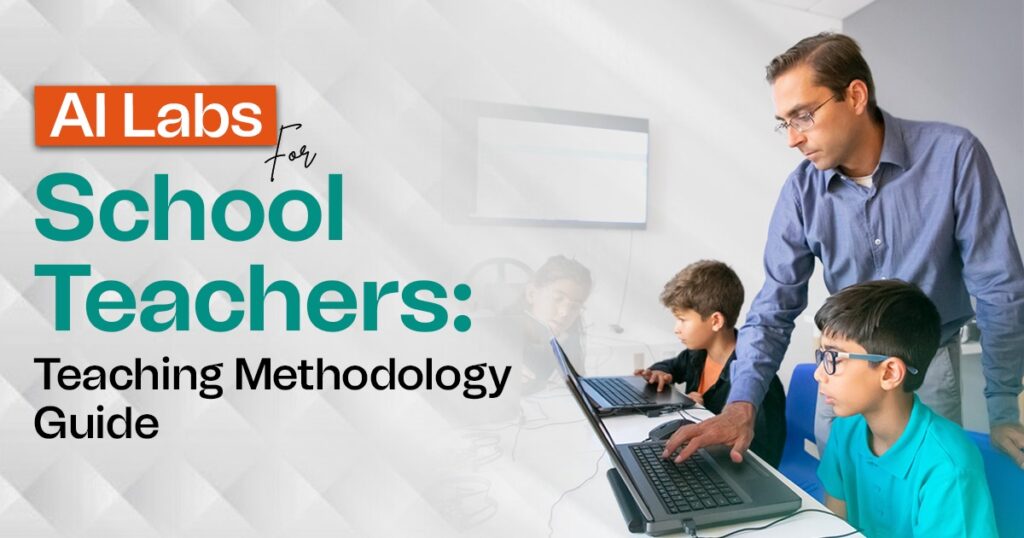
We have officially entered the age of artificial intelligence (AI). Everyone, from students to parents, is using voice assistants, recommendation systems, image recognition, and smart devices for their daily applications. Generally speaking, it’s high time AI was introduced into the curriculum. But AI isn’t a subject schools can cover theoretically. You want students to understand the tech and reasoning behind it. AI labs for school are critical to this. But before we can teach students the same, teachers need to be adequately equipped with knowledge about labs. This blog will act as a 101 guide to utilising AI labs for school teachers.
What Are AI Labs?
Artificial intelligence (AI) labs are like other subject-specific labs, but with AI-specific technology. This infrastructure is used to conduct activities and projects that explore AI concepts. However, do mind one thing: don’t confuse AI labs with robotics or computer labs. Those labs focus on hardware and general computing, respectively. An AI lab will enable students to think logically, use data to solve problems, and use AI tools ethically. Such functions underscore the importance of AI labs for school.
How to Teach AI in School: A Practical Methodology for Teachers
Implementing AI is a very simple but long process. The following three steps on how to teach AI in school will be implemented across different class levels and age groups.
- Start with AI Awareness
The most basic implementation of AI is simply telling kids about it. You are basically trying to teach students using their interests. Help them connect dots using stories and visuals, and teach them how machines learn. The aim is simply to spark their curiosity, not introduce complex coding concepts. Due to its fundamental nature, this stage is generally executed in primary classes.
- Build Conceptual Understanding
Now that children have genuine curiosity about AI and understand it at a surface level, we should start diving into the minute details of AI. Start by teaching about data, how to recognise patterns, and how simple prediction-based decision-making models work. The aim is not to introduce complex coding concepts—start with simple ones and use visuals and tools to demonstrate. This stage is generally implemented in middle school.
- Hands-On AI Projects
At the secondary level, you want to get rid of theoretical learning completely. You only want learning to be application-oriented. Start assigning projects to students. These can be image or object recognition, simple chatbots, recommendation systems, AI-based classification tasks, and discussions on the ethical use of AI. This stage will give them a gist of how AI concepts connect to real-world applications.
Teaching AI Without Overloading Teachers
AI education for teachers isn’t about making them AI specialists. It’s about providing basic AI pedagogy training so that they can help students when required. Note that the curriculum and most concepts should be self-manageable with tools hosting an intuitive interface. This doesn’t overwhelm teachers immediately and also provides proper guidance to students.
Assessment in AI-Based Learning
The effectiveness of AI education can be measured by focusing on:
- Concept understanding
- Ability to explain AI processes
- Application of ideas in projects
- Ethical reasoning and awareness
Most AI training for teachers will also cover how to gauge the efficacy of AI education.
Busting AI Lab Myths
Schools have multiple myths about AI lab setup in school. Here are some of them broken down.
| Myth | Reality |
| Too complex for school students | Taught visually and progressively |
| Specialist teachers | Structured curriculum and training |
| Expensive | Software, curriculum, and pedagogy |
| Replaces basic learning | Strengthens thinking and problem-solving skills |
Conclusion
Teachers are the primary pillar of any type of education, even AI labs. They can ensure a smooth step-by-step transition by connecting fundamental knowledge with real-world applications. Additionally, an AI lab implementation isn’t very complex. You need basic amenities in hardware, software, and curriculum, and everything will be sorted. If you don’t want to bear that headache, you can consider hiring the top ICT provider in school, and they will take care of everything from providing the necessary resources to teacher training for every class level at your school.
Frequently Asked Questions (FAQs)
At what grade level can AI be introduced in schools?
AI labs are beneficial for students at all grade levels. The difference is in alternating among awareness, conceptual, and project-based learning.
What is required for an AI lab setup in a school?
An AI lab setup in a school typically requires computers with internet access, AI learning platforms, datasets, a structured curriculum, and proper AI training for teachers. Advanced hardware is not mandatory.
How can an ICT provider support AI labs in schools?
A top ICT provider in school education supports AI labs through curriculum design, AI lab setup, teacher training, integration with ICT and STEM programs, and ongoing academic support.
