
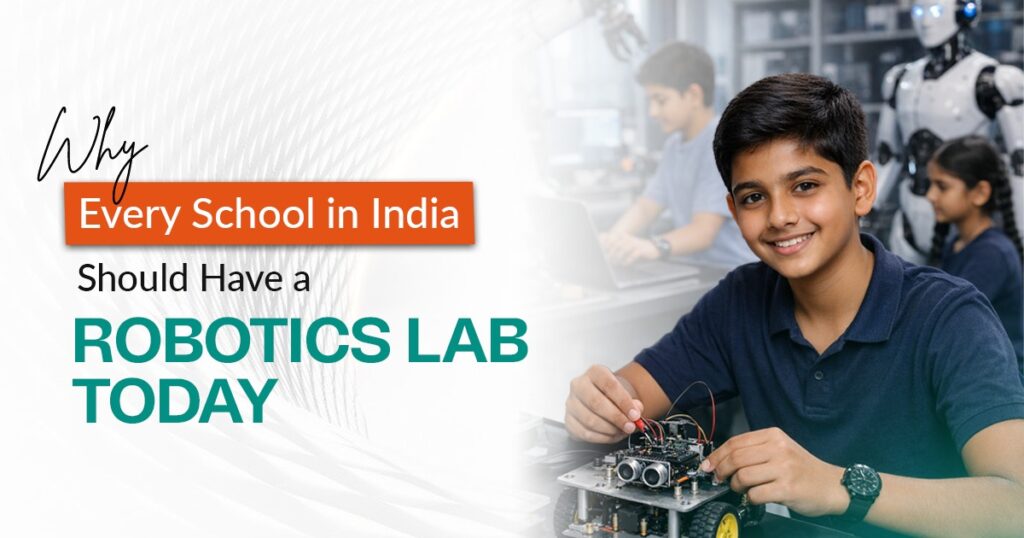
Indian education is no longer just traditional bookish coverage. Schools are moving beyond this and adopting innovative methods, such as robotics lab in school, to make students future-ready. Apart from the usual tech-enabled learning benefit, such education also develops critical thinking, problem-solving, collaboration, creativity, and digital literacy. Specifically, robotics labs build thinkers, innovators, and problem-solvers. In this blog, we’ll understand how robotics labs are becoming an essential component of modern schooling.
Why Robotics Labs Are Becoming Essential
Robotics labs are smart classrooms in schools where students can design, build, and program using robotics kits and sensors, coding platforms, engineering components, electronic tools, and AI-enabled learning modules. Unlike computer labs, robotics labs require you to work with both hardware and software and to understand how technology works. Let’s uncover the reasons robotics labs are the need of the hour in schools.
- Building 21st Century Skills for Students
Modern careers seek traits such as analytical thinking, logical reasoning, teamwork, innovation, creativity, and adaptability. A robotics lab builds these skills effortlessly. When students tinker with different mechanical and digital parts in a lab, they inherently learn 21st century skills for students that contribute to success in today’s world.
- Promoting Experiential Learning
Generally, students are expected to solve real-world scenario-based problems and create hands-on projects. It means they’re directly engaging with concepts that offer golden opportunities for experimentation and iteration to create meaningful, functional projects.
- Strengthening STEM Education in India
Robotics is a sub-section of STEM education in India, largely focused on concepts from science, technology, engineering, and mathematics. Robotics amplifies STEM education and encourages interdisciplinary thinking.
Robotics Labs vs Traditional Computer Labs
We have been claiming that robotics labs are the future of education in India. The differentiating table between robotics labs and traditional labs will tell you exactly the innovations we are looking for.
| Robotics Labs | Traditional Computer Labs |
|---|---|
| Creation and innovation | Basic software usage |
| Automation concepts | Typing skills |
| Problem-based learning | Digital literacy |
How ICT Labs Support Robotics
An ICT lab setup in school can help schools easily integrate robotics programs into the curriculum. These labs already provide essential tools, including coding environments, simulation tools, digital resources, and data analysis platforms. In short, ICT labs and robotics integration create a comprehensive learning environment that supports advanced technology education.
Mythbusting About Robotics Labs
| Myth | Fact |
| Too expensive | Scalable and adaptable to different budgets |
| Only for older students | Tailored for all age groups |
| Advanced technical expertise | Structured curriculum and training |
| Only about coding | Creativity, engineering, collaboration, and problem-solving |
Starting a Robotics Lab
To start a robotics lab for schools in India, you need to execute the following steps:
- Assessing current ICT infrastructure
- Introducing age-appropriate robotics kits
- Providing teacher training programs
- Integrating robotics into the curriculum
- Starting with pilot programs and scaling gradually
Conclusion
Robotics labs are no longer a marketing gimmick for schools. It is a genuine addition to the pedagogy of modern education, helping students to develop creativity, innovation, and problem-solving skills. Setting up a robotics lab is the best investment schools can make in technology in education India. If a robotics lab seems like a hassle for you, consider hiring a professional provider like Techno School, which can help you customize a curriculum tailored to the skills students need to thrive in the future.
Frequently Asked Questions (FAQs)
What is a robotics lab in school?
A robotics lab is a dedicated space where students interact with technical components and work on hands-on projects to develop practical skills.
Why is robotics important in schools?
Robotics facilitates STEM education in schools and helps students develop critical thinking, creativity, collaboration, and problem-solving skills, essential for future technological careers.
How do robotics labs prepare students for the future?
Robotics labs introduce students to coding fundamentals, AI and automation concepts, design thinking, and engineering workflows, essential for future careers impacted by modern technology.
