
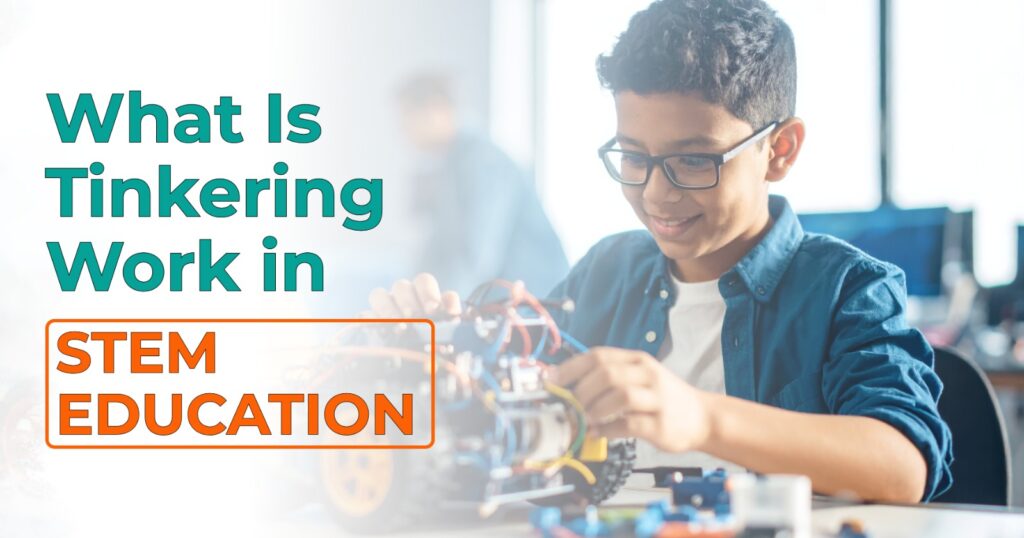
STEM education has been at the forefront of digital learning in schools today. Tinkering has been the foundation of all STEM education. It’s because STEM emphasizes problem-solving, critical thinking, and analytical skills across the disciplines of science, technology, engineering, and mathematics. And tinkering is exactly what nudges students to act, build, test, modify, and improve. Let’s dive a bit deeper into tinkering and its work in STEM education.
What Is Tinkering Work in STEM Education?
The official definition of the word “tinker” is “to try to repair or improve something without having the proper skill or knowledge.” Tinkering in STEM has a similar meaning, modified according to the context of STEM. It’s giving children the freedom to build and experiment with materials, tools, and technologies to understand concepts.
Tinkering STEM education training doesn’t encourage leading to the correct answer. Instead, promoting trial-and-error where students (instead of finding what works) understand why something doesn’t work, and eventually why something does work. Basically, the three emphases of tinkering are:
- Process > Results
- Creativity > Memorization
- Exploration > Instruction
What Is A Tinkering Lab?
What is tinkering lab and how are STEM tinkering labs different from other labs you might already have in your school? A STEM tinkering lab is a space where a strict purpose does not guide students. They are given access to tools, materials, and technology to foster open-ended exploration. STEM labs in schools differ from traditional labs that host predefined experiments by encouraging the try-fail-improve iterative process.
How Tinkering Fits into STEM Education
| Component | Practices |
| Science | Observation, experimentation, hypothesis testing |
| Technology | Coding, digital tools, electronics |
| Engineering | Designing, building, testing, improving solutions |
| Mathematics | Measurement, logic, calculations, pattern recognition |
Benefits of Tinkering Work for Students
Tinkering offers some of the core benefits of STEM education. These include:
- Stronger problem-solving skills: When students experiment with the tools and technology provided to them, they understand problems better, analyze them quickly, and improve outcomes independently.
- Critical and logical thinking: Tinkering requires students to experiment and build through their processes and methods. It creates deep cause-and-effect patterns in children that foster logical and critical thinking, vital for future endeavors.
- Creativity and innovation: Studies show that high intellectual traits, such as those we mentioned in previous points, also enhance general creativity. Similarly, tinkering encourages original thinking among students.
- Confidence and ownership of learning: Students display higher confidence in knowing and owning projects they themselves built from scratch. This fosters creativity and self-belief, two critical characteristics among children.
- Collaboration and teamwork: Most tinkering-based activities require students to collaborate in groups and build. Such activities improve communication and help students become better team workers.
- Resilience and adaptability: Students are bound to face multiple setbacks as they explore tinkering-based activities. With time, they learn to bounce back and see it as an opportunity, building resilience and adaptability.
Common Myths About Tinkering Labs
| Myth | Reality |
| Only for gifted students | All learners with varying skill levels |
| Expensive infrastructure | Simple, affordable tools |
| No academic value | Core academic and cognitive skills |
| Unmanageable for teachers | Structured and effective |
Conclusion
Tinkering is not just for STEM education. It goes beyond it and is one of the core techniques by which students learn. It encourages active exploration, helping students become thinkers, problem-solvers, and innovators. Schools would have to adapt tinkering labs quicker or sooner to make learning meaningful. If the adoption is challenging, consider hiring a STEM & ICT solution for schools in India; they’ll handle everything with a customized STEM and tinkering roadmap.
Frequently Asked Questions (FAQs)
What is the meaning of tinker?
In general, tinker means trying to repair or improve something without the proper skill or knowledge. However, in the STEM context, it refers to hands-on learning through experimentation using tools and tech.
What is the use of a tinkering lab?
A tinkering lab encourages innovation, problem-solving, open-ended exploration, and creativity.
Can tinkering be implemented within existing STEM labs in schools?
Yes, tinkering can be implemented within existing STEM labs. The school already has the technology. All it needs to do is organize weekly or bi-weekly tinkering sessions.
