
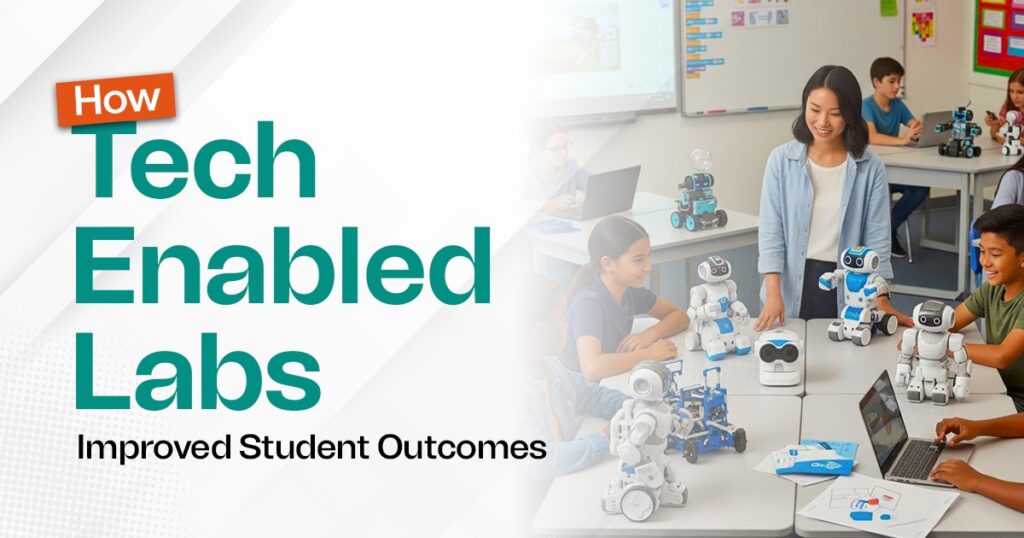
The present era is consistently moving along a path where the rise of digitalization in every sector is inevitable, including education. More than the teachers, the students in their age of learning benefit from the use of advanced digital tools, which speaks for the demand for tech-enabled labs. Typically, STEM labs in schools equipped with the latest technology give the school and students access to IoT tools, robotics, cloud systems, and AI tools, taught as a blend of traditional teaching practices and modern tech.
What Do Technology Enabled Learning Labs Include?
The primary factor behind the use of technology enabled learning labs is to make learning more interactive and practical for students. At such labs, school students get hands-on experience with real-world tasks without any actual risk, explore complex concepts visually, and gain industrial skills. The following are some significant components that make the integration of tech-enabled labs in schools highly demanded:
1. IoT Tools
There are several Internet of Things (IoT) devices that can be used by students in their tech-enabled labs for them to work with real-time data and automated systems. It includes tools such as smart sensors, temperature monitors, and connected lab devices that help students understand modern, smart technologies. The following are some benefits of IoT tools for students:
- Real-time monitoring of data like temperature, humidity, pH, or voltage, making experiments more practical behavior.
- Experience of the functioning of actual setups used industrially.
- Understanding of system behaviour and failure points with the feedback of the device.
2. AI and Robotics Kits
Tech-enabled labs are equipped with AI tools and robotics kits that help students design, build, and program automated machines. The following are some learnings and experiences the young minds gain:
- Python, C++, or block coding to program robots or AI systems.
- Experiments regarding the functioning and development of robotic arms, sensors, and motion systems.
- Creation of mini robotics systems for projects or assessments.
3. Cloud-Based Systems
Cloud platforms facilitate the collaborative online use and access of virtual labs, software tools, and stored data. The following are some key features of cloud systems in STEM labs in schools:
- Students can run complex simulations or programs on the cloud.
- Multiple students can work on the same project in real time, teaching them about the use of cloud environments on an industrial level.
4. Specialized Industry Tools
Every sector has several tools specific to it, i.e., tools whose use lies nowhere else but in a particular industry, such as healthcare, engineering, aviation, etc. Students, based on their specific stream, experience the usage of these tools as an impact of STEM labs on student learning, with benefits like:
- Students get early exposure to equipment they’ll use in real workplaces in the future.
- Students learn the correct methods of handling, calibrating, and interpreting machinery output.
- Experience of realistic lab setups adds confidence in students for their future.
What Are the Benefits of Tech-Enabled Labs?
There are several benefits of tech based education labs for students that play a crucial role in strengthening their academic and career outcomes. The following are the benefits that explain what is a STEM lab and why its integration is important in modern schools:
1. Skill Development
A successful career in any industry requires a proper blend of soft and hard skills that students develop through practical experience in the modern tech-enabled labs. The following are a few of those skills:
- Experience with the usage of coding, robotics, AI tools, IoT devices, or cloud platforms provides them with hands-on skills.
- Problems arise for students during every practical time. Solving these problems teaches them about critical thinking and helps them plan, execute, and optimize solutions.
2. Engagement in Learning
When learning becomes practical and curiosity-driven in tech-enabled labs, students’ engagement and interactivity rise significantly, which in turn leads to a longer retention of their practicals. The factors that influence this engagement include:
- Multi-sensory learning in the form of visual, audio, and physical experiences.
- Gamification of learning with the inclusion of reward-based challenges, quizzes, and missions.
- Active participation and interests rather than simply listening reduce boredom.
3. Efficient Use of Time
Learning from tech-enabled STEM labs save students a lot of time compared to long hours spent in theoretical lectures. Digital labs reduce manual setup time, allowing students to focus more on actual learning. In a virtual environment, repeated trials or experiments tend to be very quick.
4. AI-Based Metrics
When students use AI tools in tech-enabled labs, the tools also record all students’ performance, which can later be used to improve in specific areas.
- AI tools give feedback for students by highlighting strengths, weaknesses, and learning patterns and giving recommendations for improvements.
- Teachers get data-driven insights to teach their students in a better way through performance reporting dashboards.
5. Assessments
Tech-enabled labs prepare the students for the best scores in assessments of their overall learning. This test preparation is done through different software or tools that provide the score of all the students instantly at the end of the test.
6. Improvement Opportunities
When the performance of the students is tracked by AI tools, they get a clear focus on the scope of improvement as well as repeatable experiments. The following are some limitless revision opportunities they experience at a tech-based lab setup.
- Students can repeat virtual experiments multiple times until they master the concept.
- Limitless repetitions with no risk associated with them eliminate the fear of failure in students and boost confidence.
7. Risk-Free Experiments
Even the most complex tasks of a tech-enabled lab can be performed by students with barely any concern for their safety, as they are free of any form of risk.
- Learning about their experiments in virtual chemical labs, electrical circuits, or machinery allows students to practice safely before stepping into a real lab.
- Such a form of training eliminates threats like burns, shocks, or chemical spills.
Conclusion
The introduction of tech-enabled labs in schools has become a revolution in the education sector, which is being heavily adopted at present. This revolutionization results in student performance improvement through technology as an additional effort to make them practically competent, confident, and future-ready.
If you have a school and want to learn what is a STEM lab and how such a tech-led lab setup can be implemented in your building, then Techno School has the best deal for you. We at Techno School have extensive experience helping countless schools and their students across India and the UAE through our ICT and STEM education program, along with appropriate teacher training to guide students.
Many facilities like these have made us one of the best ICT solution provider in school across India and the UAE. Contact us at Techno School to fulfill the need for a tech-enabled lab setup at your school and take your school’s reputation to new heights in the eyes of the world.
FAQs
Q. How technology improves student learning?
Learning with technology enables students to gain practical experience and skills, makes them accustomed to technology at an early age, and provides them with all the necessary aspects of their curriculum with a near-perfect quality of education and in an engaging way.
Q. How can technology be used effectively to enhance learning?
Technology is used to enhance learning by making it more interactive and engaging with gamification, along with teaching different concepts in visual and audio forms.
Q. What is the role of AI in education?
AI in education is used to teach any concept to students in a quick, engaging and simplified way without being affected by limitations or restricted access to study materials.
Q. What benefit virtual labs provide over physical labs?
Virtual labs, like their name, provide all the practically used tools virtually. Such a facility eliminates the need for physical resources and eliminates any risk, harm, or expenses associated with real experiments.
Q. How is cloud computing beneficial for students?
Cloud computing eliminates the need for physical resources in the form of books or notes for students and makes all the study material and applications available to all students online through a single source.
