
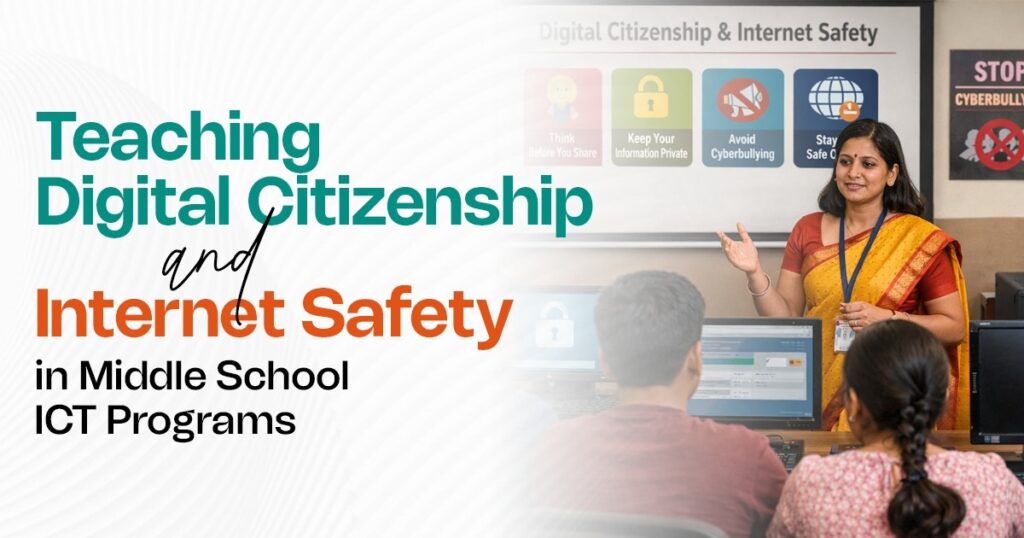
We have now moved into a world where we all reside as citizens in a world of the internet. In an age like this, schools are not only responsible for teaching students about technology, but also how to use it responsibly. This is why teaching digital citizenship is the new critical part in ICT programs, especially in programs tailored to middle school.
Middle school is given more importance because class 6-8 students are freshly independent wanderers of the internet. Their usage goes beyond academics, and they begin to engage with the internet on personal devices. That’s why integrating responsible internet use in middle school ICT programs is so crucial.
What Digital Citizenship Means in ICT Education
Digital citizenship isn’t just a theoretical concept. The literal term means the state of being a citizen of the digital country. All countries have laws, and that’s what digital citizenship stands for. It is a set of practical skills and behaviours that ensures people’s actions are safe and responsible in the world of the internet. Here is everything that it includes:
- Online safety & security
- Respectful communication
- Personal data & privacy protection
- Credible vs misleading information recognition
- Ethical technology use
Core Areas School Must Cover
| Digital Safety | Digital Behavior | Digital Responsibility |
| Creating strong passwords | Cyberbullying & its consequences | Identifying misinformation |
| Recognizing phishing attempts | Responsible communication | Avoiding plagiarism |
| Avoiding unsafe websites | Respectful online interactions | Respecting intellectual property |
| Understanding data privacy | Digital etiquette | Managing their digital footprint |
Moving Beyond Theory: How to Teach Digital Citizenship
In the coming sections, we’ll see how schools can practically teach digital citizenship in middle school.
Scenario-Based Learning
Create situations replicating real-life constants. These might include stuff like:
- What would you do if your photo is being shared without permission by someone?
- How would you respond to a hurtful comment made online about you?
This will help students think critically about the situation without actually being present in it.
Role-Playing Activities
Students can act out and build a fun game around online conflicts, data misuse, and digital communication. This gamification of digital citizenship will reduce the monotony and build empathy and understanding.
Case Study Discussions
There are numerous real-world cases about cyberbullying, online scams, and misinformation that can be discussed in the class. The discussion will force students’ brains to engage in high-level thinking and build that skill instead of memorization.
Project-Based Learning
Learning by doing is still the best practice in the teaching handbook. Assign projects such as:
- creating awareness campaigns on internet safety
- designing digital behaviour guidelines
- analyzing fake vs real news
It makes the learning interactive and relevant for students.
Integrating Digital Citizenship Into ICT Curriculum
Digital citizenship can be integrated into the ICT curriculum middle school lessons in the following (exemplar) ways:
- Internet lessons → teach safe browsing and information verification
- Coding sessions → discuss ethical use of technology
- Research projects → address plagiarism and source credibility
- Group work → reinforce digital communication etiquette
Risks Schools Must Address Proactively
The digital world hosts a lot of risks that students should be made aware of as a vital part of the ICT integration, including:
- Cyberbullying
- Online scams & phishing
- Data privacy violations
- Exposure to harmful or misleading content
- Digital addiction & overuse
Conclusion
Digital citizenship is among the most significant subjects. It is about teaching students to browse the internet responsibly, safely, and ethically. Integrating them in middle school ICT programs ensures that students learn to navigate the digital world confidently. If you need help with adopting an ICT program that integrates digital citizenship, consider hiring an ICT education provider for schools in India, and they’ll help you smooth out the process for you.
Frequently Asked Questions (FAQs)
What is teaching digital citizenship?
Digital citizenship is the safe and responsible use of technology and online behaviour modelled by students.
Is teaching digital citizenship really necessary in middle school?
Yes. Middle school is when students begin independent internet usage. Without structured guidance, they are more vulnerable to cyberbullying, misinformation, and unsafe online behaviour. Integrating digital citizenship early helps prevent these risks.
Will students take digital citizenship seriously, or see it as theory?
When taught through real-life scenarios, case studies, and activities, students engage actively. Practical learning methods make digital citizenship relevant and impactful rather than theoretical.
