
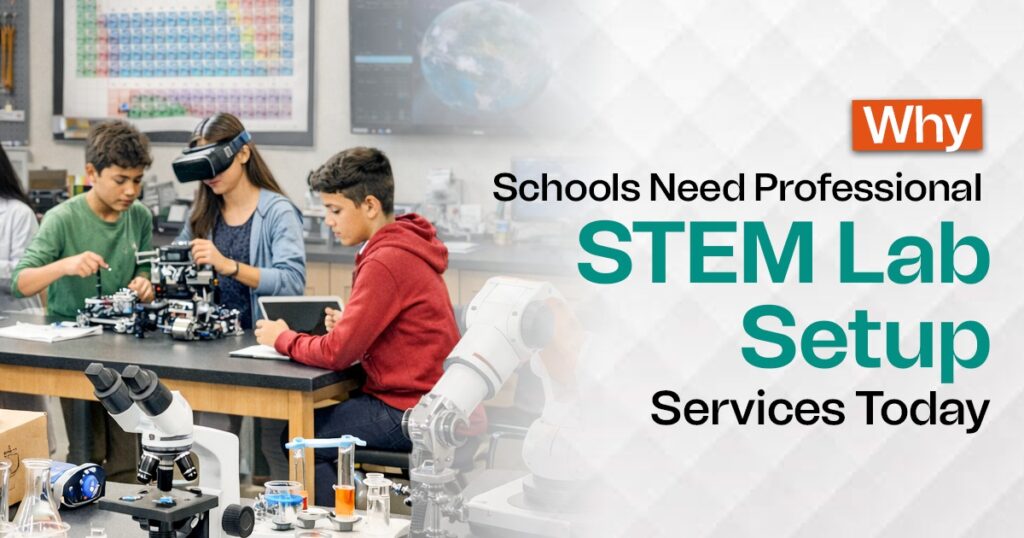
For children at any stage of their development, practical skills and learning matter as much as or more than just reading things from a textbook. To fulfill the need for practical learning that students deserve to get exposure to for their future, a STEM lab setup is considered a necessary step for schools to take. However, setting up functional STEM labs is not as simple as it sounds because the results they bring need to be backed by proper infrastructure planning, curriculum alignment, safety compliance, and technical support.
What is a STEM Lab?
In case you don’t know, a STEM lab (Science, Technology, Engineering, and Mathematics lab) is a learning space at schools where students explore concepts in the said subjects through practical experiments or by working on projects. The work of students at these STEM labs is supported by the use and learning of digital tools, coding platforms, mechanical systems, and collaborative learning models. The following are some types of STEM labs:
- Robotics & Automation Labs: Focus on robotics kits, sensors, microcontrollers, and basic concepts of AI
- Coding & Computational Labs: Are dedicated to programming, app development, and algorithmic learning
- Makerspaces/Innovation Labs: Consist of 3D printers, laser cutters, design tools, and fabrication stations
- Science Integration Labs: Combining physics, biology, and chemistry experiments with digital measurement tools
What Are the Necessary Components of a STEM Lab Setup?
A STEM lab occupied with STEM kits for schools must combine physical infrastructure, digital systems, and structured learning modules, as recommended and taken care of by professional providers. The following are the necessary components of a STEM lab with their importance:
1. Physical Infrastructure
Before installing the STEM tools, a school should ensure proper spatial planning and safety compliance by following the general school laboratory safety guidelines recommended by agencies such as the Occupational Safety and Health Administration (OSHA). This is because improper infrastructure planning can lead to safety risks for the school staff as well as students. Key elements of these guidelines include:
- Adequate ventilation and lighting
- Anti-static flooring (for electronics labs)
- Fire safety equipment and first-aid kits
- Safe wiring and grounded electrical outlets
- Ergonomic furniture suited to student age groups
2. Equipment and Technology Stack
The equipment used in the labs must match the learning objectives of the children. Without structured teaching of the provided equipment and technology, there is a huge probability that students would use devices randomly and improperly rather than master them. The core equipment typically includes:
- Robotics kits and sensors
- Laptops or desktops
- STEM experiment kits
- IoT components
3. Curriculum Integration and Lesson Planning
Not just technology helps in giving the best possible learning outcomes but also proper STEM curriculum and teaching approach. This ensures STEM labs in schools support academic performance rather than functioning as just some rooms. Professional STEM education courses providers typically map lab activities to:
- National curriculum standards
- Skill-based frameworks
- Design thinking models
- Bloom’s Taxonomy levels
4. Teacher Training and Capacity Building
One of the most overlooked but important aspects of STEM lab implementation is preparing the teachers to use them effectively for the overall benefit of students. While teachers are not readily trained to maintain and work at STEM labs, a STEM and ICT education provider for schools in India teaches them with the help of:
- Hands-on teacher workshops
- Instructional manuals
- Online support platforms
- Ongoing technical helplines
What Are the Benefits of STEM Learning?
STEM education is needed at schools in the present time to improve the problem-solving skills, logical reasoning, and innovation skills of students. The many benefits of STEM learning, explained in detail, are:
Academic and Cognitive Benefits
The theoretical learning of students is enhanced by the related concepts they learn practically. Students engaged in STEM activities benefit from:
- Better conceptual clarity
- Better analytical thinking
- Enhanced computational reasoning
Career Readiness and Employability
To gain expertise in domains such as AI, renewable energy, and automation, students need technical skills. Among these technical skills, analytical thinking and technology literacy are among the top skills demanded in organizations all across the globe. The STEM labs help in the development of these skills by exposing students to:
- Coding logic
- Engineering design processes
- Data analysis fundamentals
- Prototype testing and iteration
Innovation and Entrepreneurial Mindset
Innovation is the result of proper exposure to experimentation and failure tolerance, both of which students learn during their time at STEM labs. A STEM lab promotes:
- Team collaboration
- Rapid prototyping
- Problem identification and solution building
Conclusion
A better present and future for school children is the result of learning through STEM labs. For the learning and skill development to be at its most advanced stage, it is important that you choose the best possible provider of STEM classes.
Contact Techno School, the best provider of STEM lab setup services for schools in India and UAE, and make your school ready for the future of education.
FAQs
Q. How to setup a STEM lab?
Setting up a STEM lab is a long process of preparing an appropriate space, electrical and network connections, getting appropriate equipment, and preparing the teachers for working at and maintaining the STEM labs.
Q. What is the purpose of a STEM lab?
A STEM lab is beneficial to improve the conceptual understanding of students, along with skill development and innovation through practical experimentation.
Q. What is the best age to start STEM?
Experts recommend that the age of 5 years old is the best to start STEM learning.

One Response