
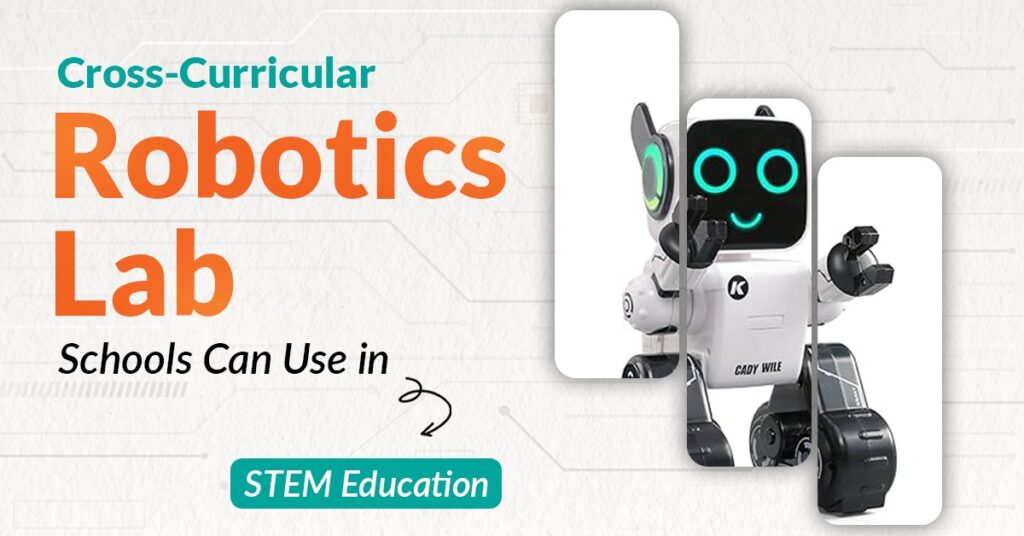
Most schools treat robotics education as a separate subject, with a curriculum limited to coding or computer science classes. However, if a school wants to provide the best educational experience for the robotics program, it must understand cross-curricular learning. Its simple definition is treating the following subjects as one unit (rather than separate):
- Science
- Mathematics
- Technology
- Engineering
- Communication skills
It provides real-world exposure to problems where every issue at hand requires you to use knowledge from all domains. However, cross-curricular learning in robotics will require you to assign school robotics lab projects that help you achieve that. Let’s understand which projects can prepare students for real-world learning.
Cross-Curricular STEM Education Robotics Projects for Schools
| Integration | Project | Concepts Covered | Skills Developed |
| Science | Smart Irrigation System | Soil & water scienceSensors & automationEnvironmental awareness | ObservationScientific testingData interpretation |
| Weather Monitoring Robot | Temperature & humidityClimate & weather patternsData collection | Scientific analysisPattern recognitionReporting & interpretation | |
| Mathematics | Line-Following Robot | Angles & geometrySpeed & distance calculationsMeasurement & precision | Logical thinkingMathematical applicationAnalytical reasoning |
| Maze Navigation Challenge | Coordinates & mappingPath optimizationSequential logic | Problem-solvingStrategic thinkingAlgorithmic reasoning | |
| Computer Science | Obstacle Detection Robot | Coding fundamentalsSensor integrationAutomation logic | ProgrammingDebuggingComputational thinking |
| AI-Based Chatbot Integration | Artificial intelligence basicsNatural language interactionDecision-making systems | AI awarenessData handlingLogic building | |
| Social Science | Smart Traffic Management Model | Urban planningCivic infrastructureTransportation systems | Social problem-solvingSystems thinkingCollaborative planning |
| Disaster Response Robot | Emergency response systemsGeography & disaster managementHuman-centered design | Critical thinkingCreativityEmpathy-driven innovation | |
| Language & Communication | Robotics Storytelling | Communication structureCreative writingPublic speaking | Presentation skillsTeam collaborationConfidence building |
| Project Documentation | Technical writingReporting & reflectionStructured communication | Clarity of thoughtDocumentation skillsAnalytical explanation |
Why Many Projects Fail in Schools
Most programs that cover robotics in STEM education fail to execute cross-curricular learning because of the following mistakes in projects:
- Disconnection from the curriculum
- One-time activity treatment
- Unalignment with STEM outcomes
- Non-teacher conduction
These might provide a good kickstart, but plateau in the longer term.
Schools also need to understand that robotics isn’t only tech-focused. It also builds general skills. So, prejudices that only computer science students or tech teachers can contribute to this should also be eradicated. Teachers and students from all domains can benefit from this with a moderate time investment.
Role of Teachers
Even the best STEM education provider India considers teachers as the most important constituents of a successful program. The key is collaboration among teachers. Teachers from different departments should work together to provide students with the best possible integrated experience. For example:
- Science teachers explain scientific principles
- Math teachers support calculations and logic
- Computer teachers guide coding
- Language teachers help with presentations and reporting
All for the same project. In that sense, the role of teachers in STEM projects shifts from being lecturers (guidance) to facilitators (exploration).
Conclusion
Robotics is no longer an extracurricular activity that is integrated into the curriculum for the sake of it. Modern STEM learning revolves around robotics and its projects. Today, it demands that all subjects work closely and connect components to provide real-world learning experiences. Even an IcatCT eduion provider for schools in India focuses on enabling teachers to become better collaborators, creating learning environments that are more engaging and practical.
Frequently Asked Questions (FAQs)
Is robotics a co-curricular activity?
No, robotics is no longer just a co-curricular activity. It has become the primary constituent of modern curricula.
Which are the best projects in robotics?
The best robotics projects are those that integrate multiple subjects and provide all-around learning.
How is STEM used in robotics?
STEM makes cross-curricular learning possible in robotics by integrating science, technology, engineering, and mathematics. Modern alternatives (like STEAM) also include art, language, and social studies.
